At Capo Vaticano, in the early afternoon, the sea seemed to be exactly the colour the photographs had promised.
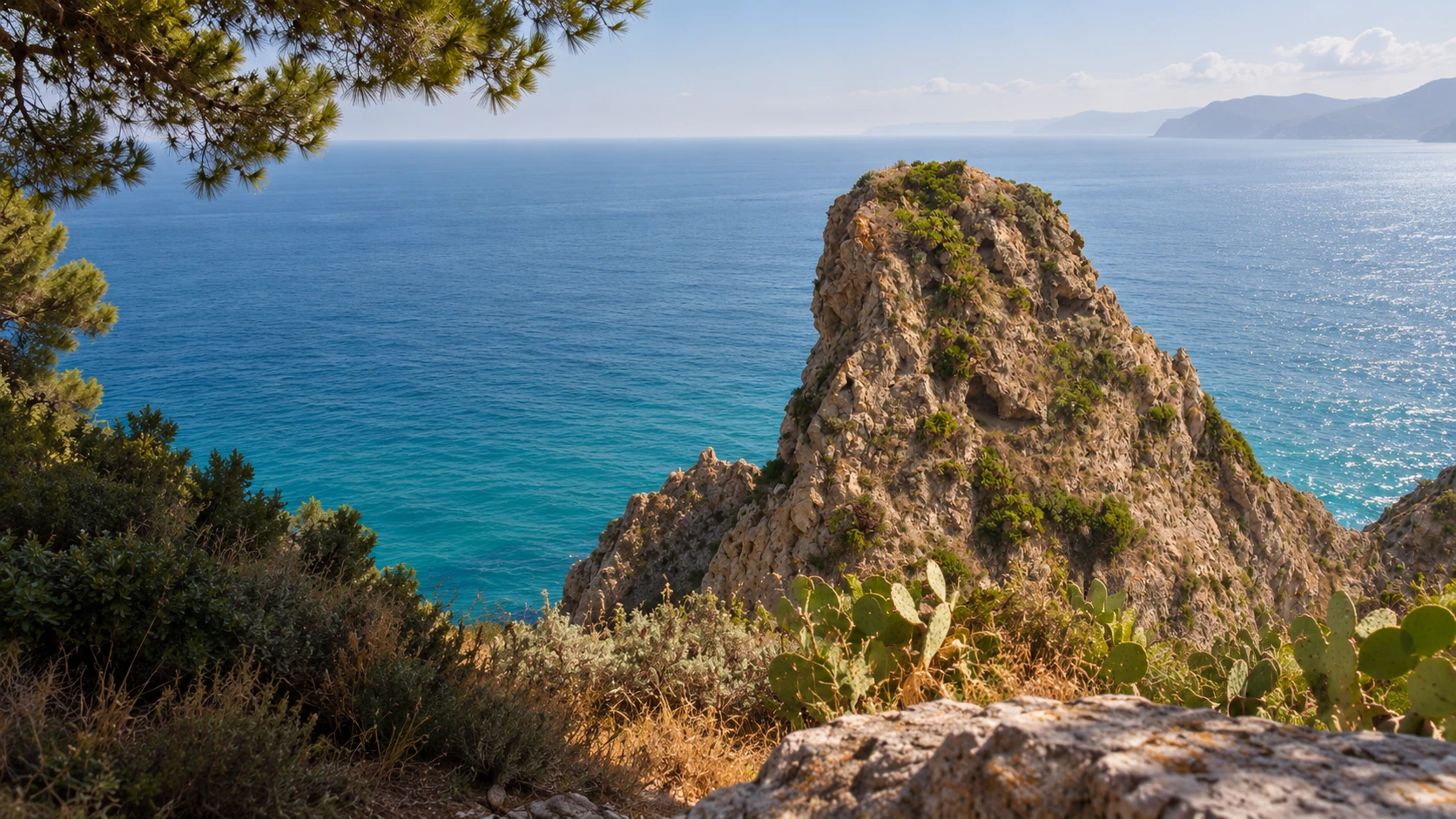
From the bench in the shade of the pine tree, he could see the coast plunging towards the water, the pale coves between the rocks and, farther away, the outline of the islands blurred by haze. The sweet scent of ripe figs mingled in the air with resin and sea salt.
He had arrived that morning and done what he almost always did when visiting somewhere new: walked, read the signs, sought out the places he had noted before leaving, and taken far more photographs than he would readily have admitted.
Now he was scrolling through the pictures on his camera.
One was particularly good. The coast entered the frame from the left, the sea filled almost everything else, and a small boat gave a sense of distance. He looked at it with satisfaction, then found himself laughing: it was almost identical to the photograph he had seen in the guidebook.
He looked up.
He certainly could not complain. Capo Vaticano was magnificent, perhaps even more beautiful in person. The people who had told him about it had not exaggerated, and the photographs had not lied either. Yet after a morning spent walking, reading, observing and taking pictures, he realised with some embarrassment that nothing in particular had happened.
Of course, there was no reason why anything should happen. He had come to see a beautiful place and found a beautiful place. Perhaps that was precisely the problem: he had imagined it so often before arriving that reality was left with the rather thankless task of surprising him.
He switched off the camera.
“Is that all?” he murmured.
He immediately smiled at his own expectations. What else was there supposed to be?
He leaned back against the bench, and it was then that he really noticed the cliff.
It jutted out towards the sea not far from the viewpoint. In the air shimmering with heat, the granite seemed to change shape depending on how he looked at it. The summit might have been a slightly bowed head; a few bushes traced something resembling a beard, and two great projections looked like the shoulders of a giant seated before the horizon.
He narrowed his eyes.
Now he could see it clearly.
“You certainly found yourself a good spot.”
The cicadas went on chirring. The heat was making his eyelids heavy, and he closed his eyes just to rest them.
“I didn’t choose it.”
His eyes flew open.
He sat perfectly still, listening. Then he looked towards the path, beyond the low wall and behind the bench. There was no one.
He thought he must have fallen asleep.
“Is someone there?”
“You were looking at me.”
This time the voice had come from the cliff.
He stood up. Took a few steps towards the low wall and stopped.
Before him there was nothing but granite, bushes and that strange figure that had amused him a moment earlier.
“Wait a moment. Was that you speaking?”
“You spoke first. It seemed rude not to answer.”
The man kept staring at it.
He searched again for someone among the trees, then turned back to the cliff.
“But you’re a rock.”
“A cliff.”
It took him a few seconds to realise the correction was serious.
“That’s the important part?”
“Quite important to me.”
A laugh escaped him, more from disbelief than amusement.
“I’m dreaming.”
“Possibly.”
“And you don’t know?”
“It’s your dream.”
The man passed a hand over his face. He looked for a loudspeaker among the bushes, someone hidden behind the vegetation, anything that might restore a little order to the situation.
In the end he sat down again.
“All right. Let’s pretend this is normal.”
“There’s no need.”
“What?”
“For it to be normal.”
The man looked at the cliff and smiled.
“We agree on that.”
A boat was passing far out from the coast. The man followed it with his eyes until it disappeared behind the rock.
Then he looked back at the giant.
“Do you have a name?”
The voice was slow to answer.
“I’ve had names.”
“And which one do you use now?”
“None, usually.”
“I imagine not many people ask.”
“No.”
The man waited, but the cliff seemed to have finished.
“So?”
“A long time ago, someone called me the Guardian.”
“Guardian of what?”
“He didn’t say.”
The answer surprised him.
“And you didn’t ask?”
“I didn’t talk much then.”
The man smiled.
“And now?”
“It depends on who stops.”
This time he was the one who let the conversation lapse.
He picked up his camera and, almost playfully, raised it towards the cliff.
“May I take your photograph?”
“You probably already have.”
He checked the morning’s pictures. In one of them, at the right-hand edge of the frame, there was the cliff.
“You’re right.”
He enlarged the image.
“And I hadn’t even noticed you were there.”
The Guardian did not reply.
The man went on studying the photograph. He had framed it carefully, waited for a boat to reach the right spot, even checked that the horizon was straight. The cliff, on the other hand, had found its way into the picture by chance.
“I must have taken fifty since this morning.”
“You enjoy taking photographs.”
“Very much.”
“Then that’s not too many.”
The man looked up, almost surprised.
“I thought you’d tell me to stop and enjoy the moment.”
“Why?”
“I don’t know. It’s the sort of thing wise men say.”
“I don’t know many.”
He laughed.
“You disappoint me. An ancient cliff that speaks, and not a single great truth.”
“Is that all?”
The man recognised his own words and burst out laughing.
“You had that one ready.”
“Only recently.”
The conversation went on, and the man could not quite have said when talking to a cliff had stopped seeming absurd.
He spoke a little about his journey, the places he had visited that morning and those he still meant to see. The Guardian listened more than he spoke, and now and then returned to details the man had mentioned almost by chance.
That was how the story of the church came up.
Years earlier he had walked almost forty minutes in the rain to reach a church a guidebook described as unmissable. When he arrived, it was closed.
“I stood outside for at least ten minutes. As though staring at the door long enough might persuade it to open.”
“Did it work?”
“It started raining harder.”
The Guardian said nothing, and the man laughed at the memory.
“There was a woman at a window in the house opposite. She kept watching me. In the end I think she stayed just to see how long I’d last.”
“Who won?”
“She did. When the water started getting into my shoes, I gave up.”
The memory had returned with startling clarity: the dark door, the water running down the street, even the curtains at the window.
“The absurd thing is that I never saw that church.”
“But you’re still there.”
The man turned towards the cliff.
“Where?”
“Outside the door.”
He thought about it.
“Yes. Actually, yes.”
Below them the sea kept moving, and cicadas filled the air.
“Perhaps that’s the kind of thing I was hoping for today.”
The Guardian let a few seconds pass.
“A closed church?”
The man laughed.
“No. Something I didn’t already know.”
The cliff was silent for so long that he thought it would not answer.
Then it said:
“A long time ago, two men stopped here.”
The Guardian did not remember their names. One had come from far away and had longed to see that sea for years. He spoke of it with enthusiasm, pointing out the islands, the colours of the water, the coast. He said it was even more beautiful than he had imagined.
The other had listened for a while.
Then he had asked why he had come.
“For the view, I imagine.”
“More or less.”
The man smiled. “An easy question.”
“It seemed so.”
The Guardian said the other man had pointed to the sea. If that was what he had come for, he had told him, then he had found it. It was right there before him, even more beautiful than he had hoped.
And yet he kept talking as though he were still waiting for something.
The man stopped fiddling with his camera.
“And what did he answer?”
“Nothing.”
“Nothing?”
“After a while they left.”
The man looked at the sea, then at the cliff.
“And you stayed.”
“I stay.”
Those two words sounded different to him.
“Did you think about it?”
“From time to time.”
“For how long?”
“I couldn’t tell you in your way of counting.”
The man smiled.
“And after all this time, you still haven’t understood what he was waiting for?”
“I’ve heard many answers.”
“But which is the right one?”
The Guardian was silent for a moment.
“If I knew, I would have stopped listening.”
The man stared at him.
Then a smile slowly appeared on his face.
“At last.”
“What?”
“The wise man’s saying. I was beginning to think it would never come.”
“I’m sorry.”
“Why?”
“It slipped out.”
The man laughed.
A boat was crossing the stretch of sea below them. He picked up the camera and framed the shot. He waited for it to reach the right spot, rested his finger on the button and closed one eye.
When he opened it again, the sun had sunk lower.
The camera was still in his hands. The sea lay before him, and the scent of figs had not changed.
The cliff was still there too.
Granite, bushes, shade.
He looked at it.
For a few seconds he saw nothing else.
Then he tilted his head just a little.
A projection became a shoulder. Higher up, the outline of a head appeared, and the bushes traced a beard again.
The giant was still there.
He said nothing.
The man raised the camera, then stopped before he had even brought it to his eye.
He lowered his hands.
He simply stayed there, looking at him.
When he checked the screen, he found that the boat was far away by now. He had not taken the picture.
Instead he found the photograph from that morning.
The cliff was still at the edge of the frame, almost cut off.
The same photograph.
The same rock.
Yet now his eyes went straight to it.
He switched off the camera.
A little farther on, the path divided. A sign pointed to another viewpoint he had noted before leaving. He knew how far away it was, had seen photographs and even remembered which side offered the best view.
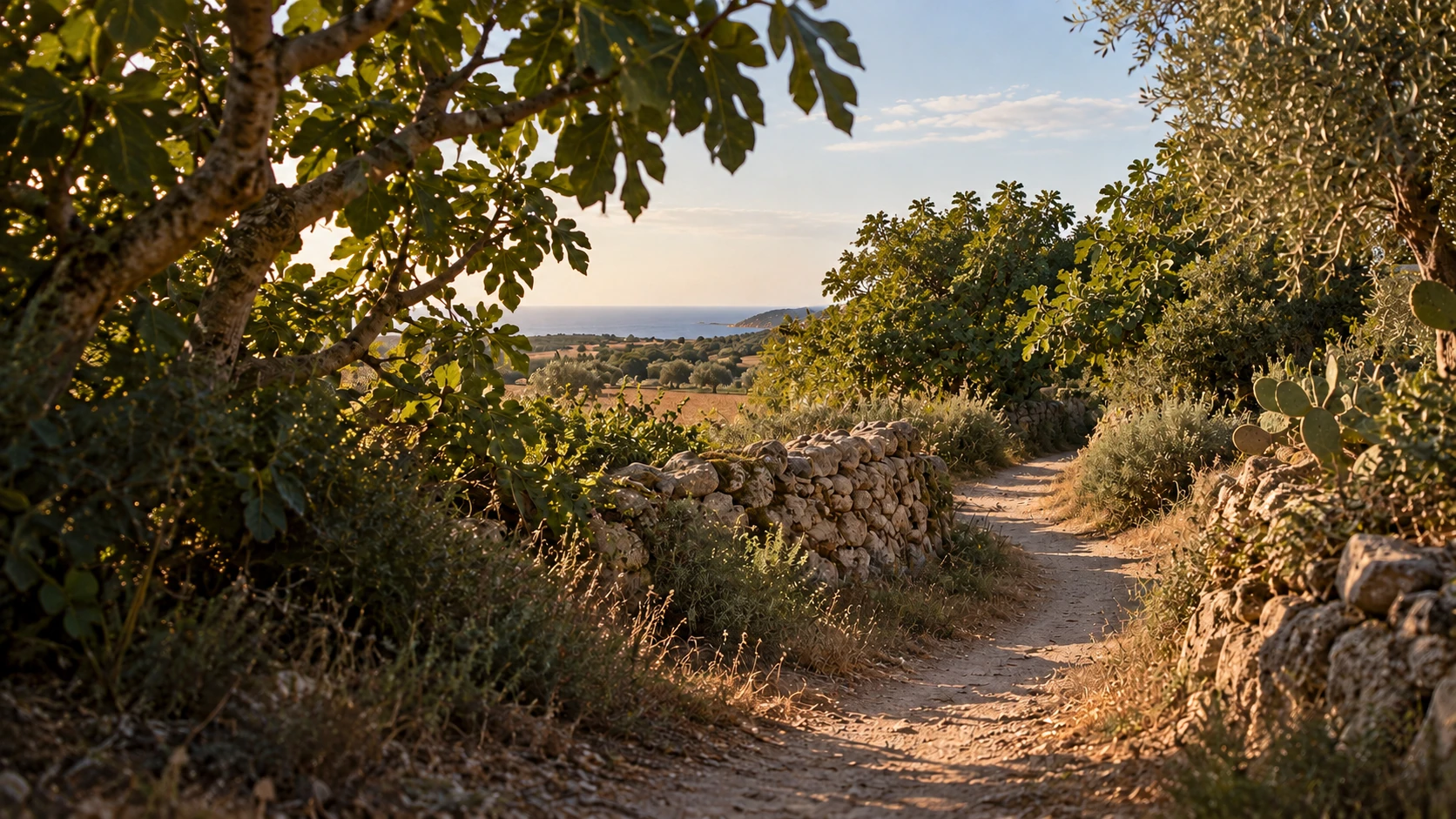
In the other direction, a narrower lane descended between fig trees and Mediterranean scrub.
There was no sign.
He looked at the sign, then at the lane.
Almost out of habit, he took out his phone and unlocked it.
He looked at the screen.
Then he put it back in his pocket.
Behind him, the Guardian went on looking at the sea.
He took the narrow lane.