After his encounter with the chocolate house, something in the way he walked had changed.
Not because everything had become interesting. He simply gave things a little more time before moving on.
That was how he saw the ruin.
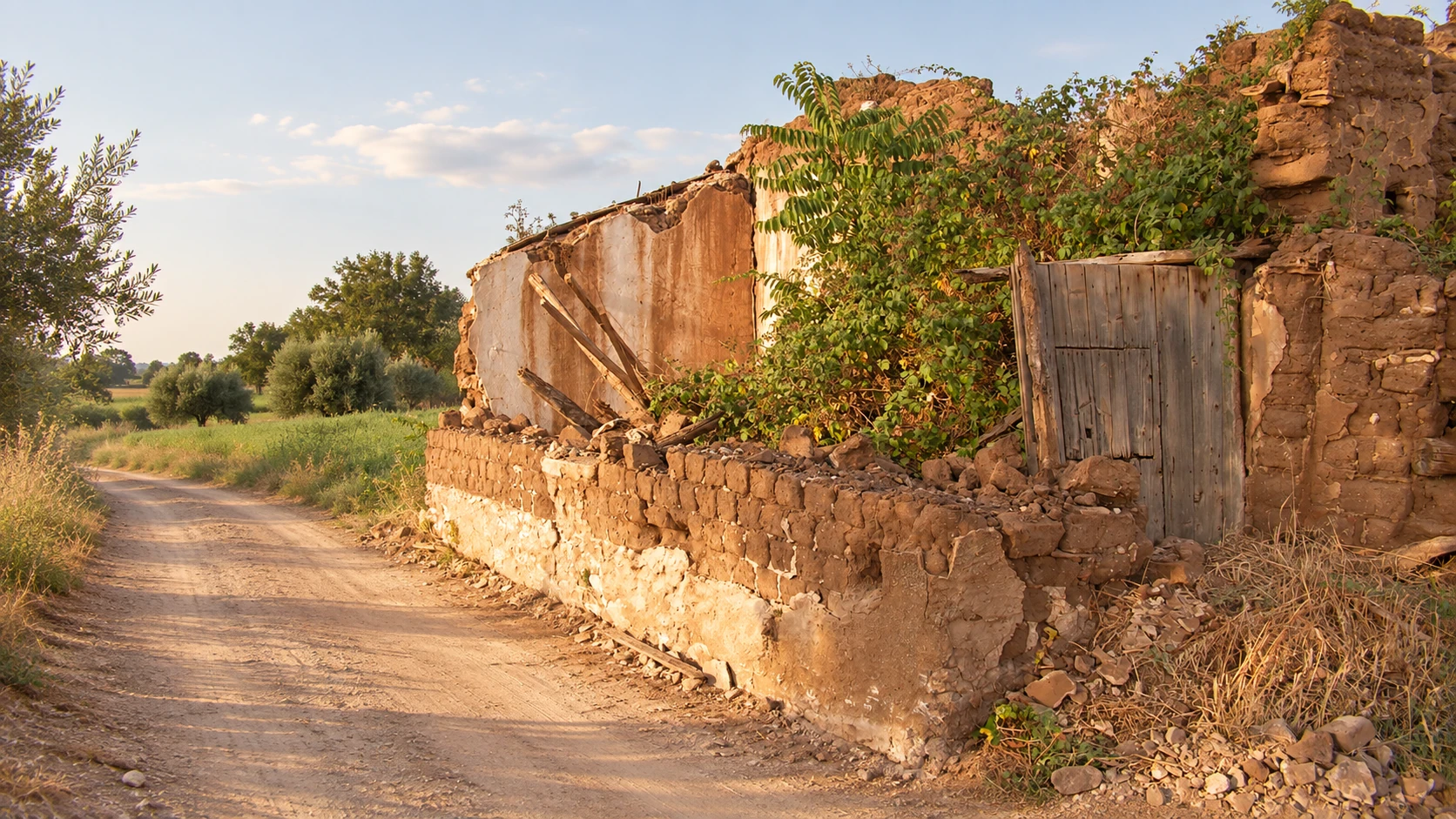
It stood a short distance from the road, almost hidden by vegetation growing wildly around the walls. Part of the building had collapsed, and what remained seemed to stand more from habit than strength: earth and stone walls, patches of plaster, leaning wooden boards and an old door still closing off a space whose boundaries were hard even to make out.
The man slowed down and looked.
He approached the wall beside the road. The earth it was built from was almost the same colour as the surrounding ground, with irregular stones showing through in places. Higher up, where the wall had broken, pieces of wood and remnants of the roof appeared; a plant had worked its way through the fallen sections and hung down towards the inside.
He walked a few steps around the perimeter. Behind an almost intact wall he found a small dark opening and bent down to look, unable to tell what it had been for.
He went on.
He could have placed a family behind that door, someone beside a window, footsteps on the beaten earth or a voice coming from inside.
He did not.
Instead he looked at what was there: the door, the walls, the earth, the wood, the fallen parts. He let the first impression lose its hold, then walked around the building again, more slowly.
Nothing happened.
He was about to return to the road when he heard footsteps behind him.
He turned around.
The man coming along the path seemed familiar, though he could not immediately tell why. He walked without hurry and carried a small bucket.
That was what made him recognise him.
It was the man from the vineyard.
The same man he had watched moving between the rows, checking the grapes and leaving a flap of netting open before walking away.
They were close enough to exchange greetings. The man with the bucket nodded in return and walked on a few steps, then noticed the visitor looking at the ruin.
“Do you know it?” the visitor asked.
The other man stopped and looked at the house.
“Yes.”
“Was it a home?”
The man with the bucket looked at the walls again.
“Three sisters lived there.”
The visitor studied the building again.
Three sisters.
The door was the same, as were the walls and the plants growing among the rubble. Yet those spaces seemed less empty.
The farmer took a few steps towards the collapsed wall.
“When I was a boy I often came this way.”
The visitor followed him.
“They had an oven in there.”
He pointed to part of the house.
The man looked where the finger was pointing. He saw earth, stones, a few broken boards and plants growing among the fallen debris.
“Where?”
The farmer pointed to the same spot again.
“There.”
The visitor moved closer. He still could not see anything resembling an oven.
“It’s gone.”
The farmer looked at the walls. Then he smiled.
“When they baked bread, if I came past at the right time they’d give me a piece fresh from the oven.”
The visitor looked again at the spot the farmer had shown him.
There was nothing there.
The farmer picked up the bucket and, with a farewell, returned to the path. The man followed him with his eyes until he disappeared behind the vegetation.
Then he turned back to the ruin.
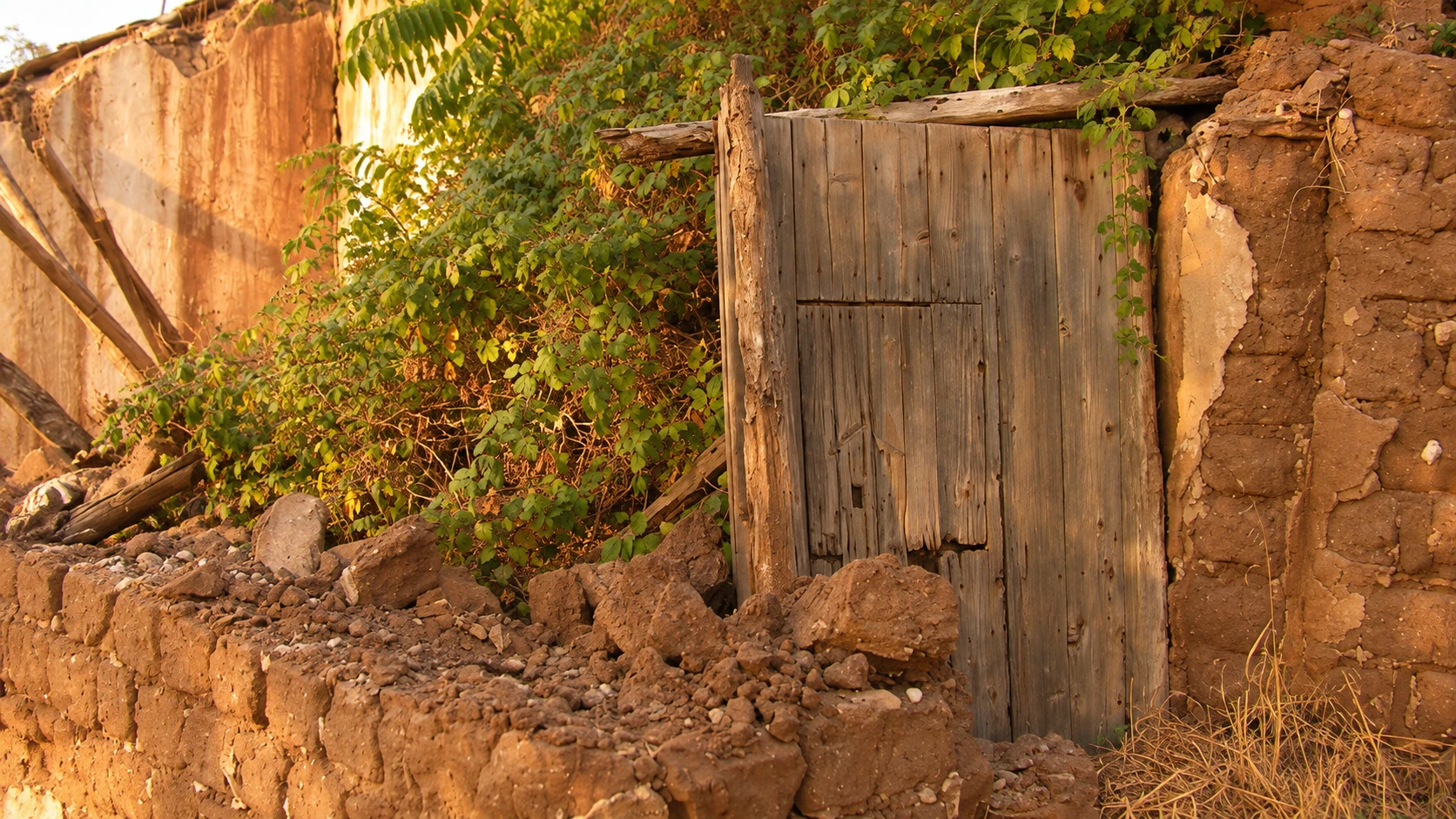
The door was the same. The walls were the same. Where the farmer had pointed there was still only earth, stone and vegetation.
He went closer.
He had walked around the building, stopped before its openings and carefully studied what remained of the walls. Yet he had seen nothing of the oven.
He returned to the spot from which he had first looked at the house.
He noticed that some parts of the wall seemed different from the rest. In one place the plaster ended along an irregular line; a little farther on a piece of wood crossed the earth and disappeared into the wall. He went closer, tried to understand, then stopped.
He did not know what he was looking at.
He reached into his pocket and took out his phone.
He remembered another house and a phone left in a pocket.
He looked at the wall again.
Then he searched.
He read a few lines, returned to the stones, searched for another word and looked again. Some answers opened up further questions; others were of no use at all. He did not find the story of the three sisters, nor did he find the oven.
He switched off the screen.
The ruin did not seem any clearer to him.
It seemed larger.
Before leaving he returned to the spot the farmer had pointed out.
He still could see nothing of the oven.
He looked once more, then returned to the road.
Farther on he passed an old wall he had seen several times before. Irregular stones showed beneath the worn plaster, and near the ground a small opening was almost hidden by grass.
He slowed down.
He looked at it.
He did not know why it was there.
He kept looking at it.
Then he took out his phone.