For a long time that insignificant gesture stayed before his eyes: a hand that had almost reached the netting and then withdrawn.
He did not know why he kept thinking about it. Perhaps precisely because he had found no explanation.
Even when he returned to the viewpoint, he did not speak of what he had seen. He stopped beside the low wall while the Guardian went on looking at the sea, then turned his gaze towards the road climbing inland.
“And now?”
“Now what?”
“Where should I go?”
The Guardian seemed to think about it.
“I don’t know.”
The man looked at him.
“Very helpful.”
“I’m improving.”
He laughed.
Then the Guardian said that an old railway ran farther inland.
“And what’s there?”
“An old railway.”
This time he laughed in earnest.
The old railway came back to mind when he set off again.
The road led away from the sea, passing fields, low walls, a few trees and stretches that seemed to exist only to lead from one place to another. There were no views to photograph, nor buildings that immediately caught the eye.
When he found the tracks, he began to follow them.
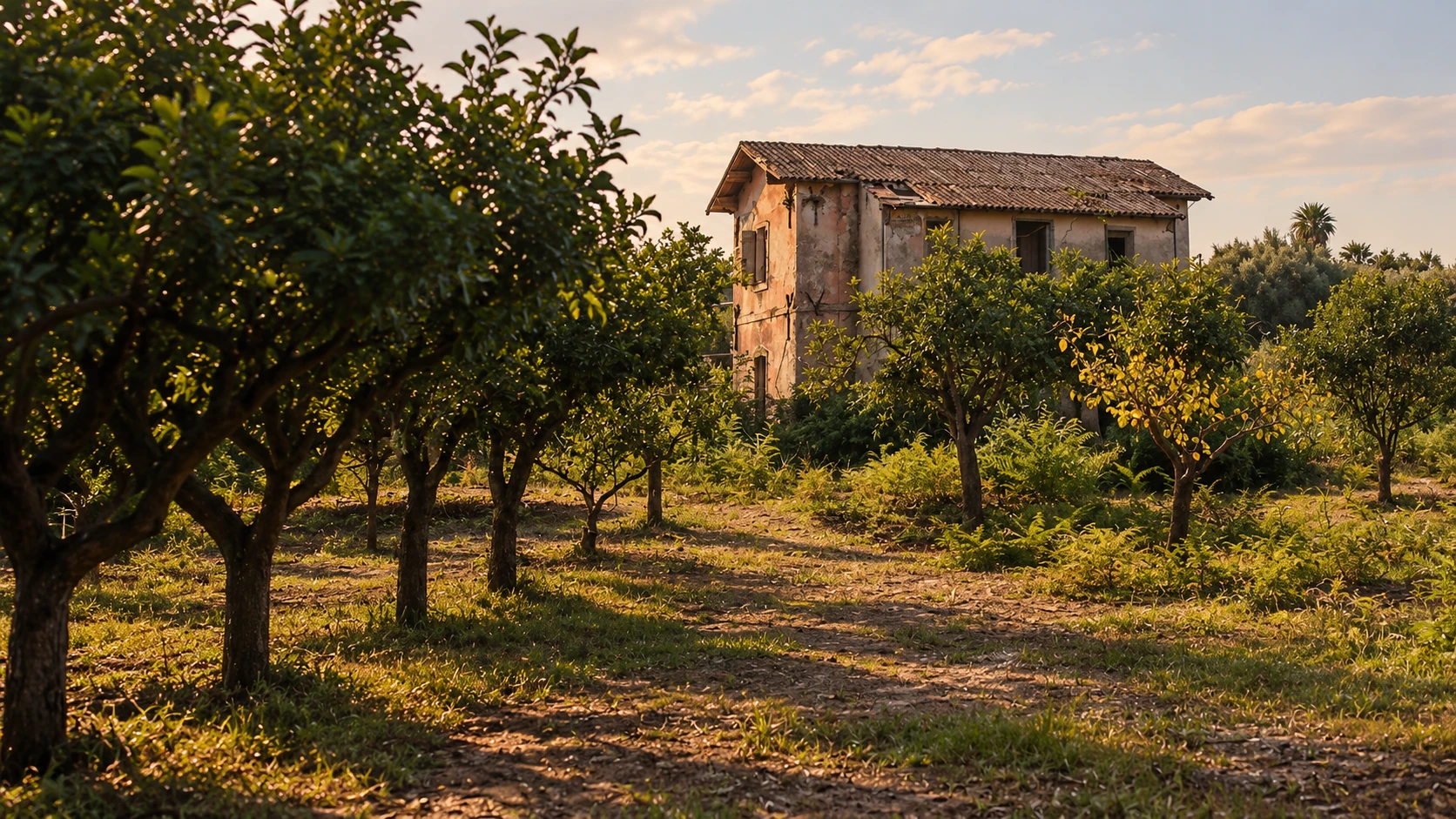
The railway keeper’s house appeared a little farther on, beside the tracks, and he recognised it before he understood why it felt so familiar. There was nothing distinctive about it: its proportions, its openings, even the way it stood beside the rails reminded him of buildings seen on journeys of which only blurred images remained.
He stopped in front of the façade.
The openings still kept a recognisable order despite the worn plaster, exposed bricks and parts that time had taken away. Beneath those wounds something regular remained, almost predictable, as though the building were still showing the plan from which it had been made.
He walked slowly around the building.
Up close, that regularity became clearer still. The windows seemed arranged to a precise measure, the openings repeated themselves without seeking any elegance, and even the remaining plaster suggested a building made to resemble other buildings.
He passed a window, then a door. He took a few steps and turned to look at them again. There was nothing that truly deserved a second glance, yet he kept moving more slowly.
On the opposite side he found another window, another stretch of wall, another empty opening. For a moment he felt he had seen that sequence before, but could not remember where.
He could have imagined who had lived in those rooms, reconstructed a life behind the windows, invented departures and returns. He did not. He continued around the building.
When he came back to the door he had passed earlier, he looked at it again.
Nothing.
He was about to leave when he lowered his eyes.
That was when he noticed the threshold.
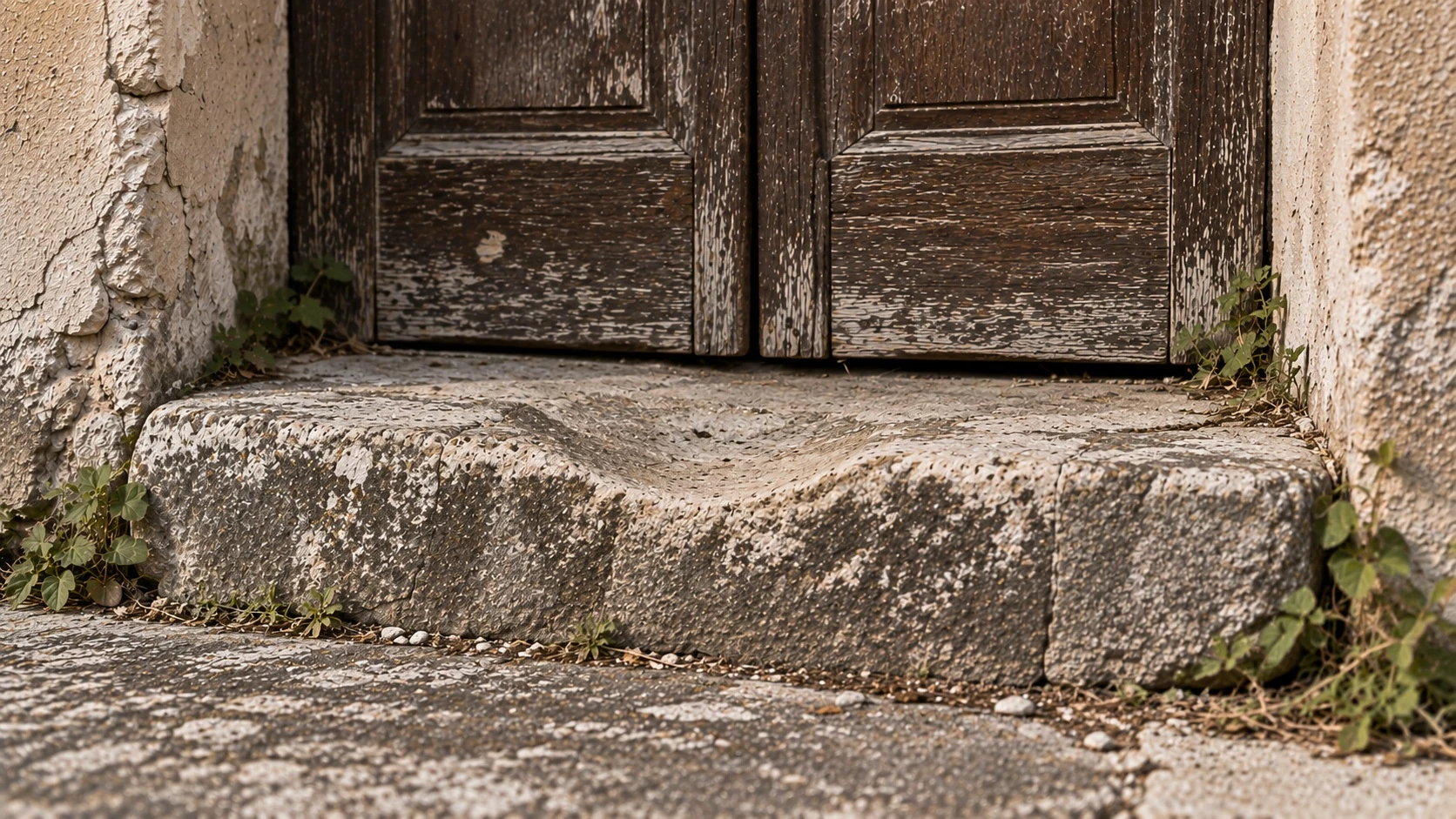
The step in front of the door was worn down most of all in the middle. At the edges the stone still had an uneven surface, while where people stepped to enter, it had become lower and surprisingly smooth.
He bent down and slowly ran a finger over the worn part.
Someone had passed that way, and must have done so long enough for a stone still to bear the trace of those crossings.
He straightened and looked at the building again, but now the familiarity he had felt on arrival seemed different. He wondered how many houses like this had been built along the railways, probably all from similar measurements, the same proportions and perhaps even the same plan.
He wanted to check.
He reached towards his pocket and brushed the phone, then stopped.
He left it where it was.
He looked at the threshold again.
If those railway houses really had been built in the same way, then at first this step too must have been just like many others: its edges still sharp, its surface rough, no trace where the stone now looked almost polished.
He tried to imagine it like that, then looked again at what lay before him.
Which step had changed it?
The question came almost playfully, but stayed.
The first certainly had not been enough, nor those that followed soon after. Perhaps it had taken hundreds of crossings, perhaps thousands, and none of those who had gone through the door had noticed that something beneath their feet was slowly changing.
He tried to single out one of those steps, but every attempt seemed pointless. Each was too small to have done it alone, and at the same time none could be ruled out entirely.
He put one foot on the step and looked at the toe of his shoe on the smooth stone. Then he entered the house, looked at what remained inside and came out again.
Before leaving, he turned towards the door once more.
His step had left no mark.
Of course.
And yet, as he returned to the road, the question stayed with him.
On the way back he realised he had looked at least three times at where he was putting his feet. He was not searching for anything, and noticed only afterwards.
At a fork he recognised the road that would take him back to the viewpoint.
He looked at it.
Then he continued in the opposite direction.
Some time later he passed an old building that had nothing to do with a railway.
He was walking without paying particular attention when, on reaching the door, he slowed. He took a few more steps, then stopped and went back.
There was a stone threshold in front of the entrance.
He bent down.
This one too was worn in the middle.
He brushed it with two fingers, following the smooth surface.
He did not search for a story.
Then he straightened.
Before setting off again, he looked once more at the threshold.
He did not wonder who had passed.
He wondered which step.
And he went on.