The man went on looking at the wall emerging among the trees.
He did not know whether there was a story inside, and felt no need to invent one.
When he returned to the viewpoint he said nothing. He stopped beside the low wall and looked at the sea, almost expecting the Guardian to ask him something. The Guardian kept watching the horizon.
It was the Guardian who broke the silence.
“Do you see that man?”
The man followed his gaze.
Farther down, along a road crossing the fields, someone was walking slowly with a small bucket in his hand. From that distance he could make out little else.
“Yes.”
“What should I be looking at?”
“Him.”
The man looked at the figure again.
“Who is he?”
“I don’t know.”
The answer surprised him. He looked at the Guardian, certain an explanation would follow.
None came.
The man looked back towards the road.
The figure with the bucket went on walking unhurriedly and soon disappeared behind the vegetation.
“Is that all?”
“You saw a man.”
“I’d worked that out.”
Before him the sea filled almost the entire horizon and, farther down, the road along which the stranger had vanished was visible only in patches between the trees.
He could have stayed there.
Instead his eyes kept searching for the point where the man had disappeared.
He did not know who he was, where he was going, or why the Guardian had drawn his attention to him. Perhaps that was precisely why he stepped away from the wall.
The Guardian went on looking at the sea.
The man took the road.
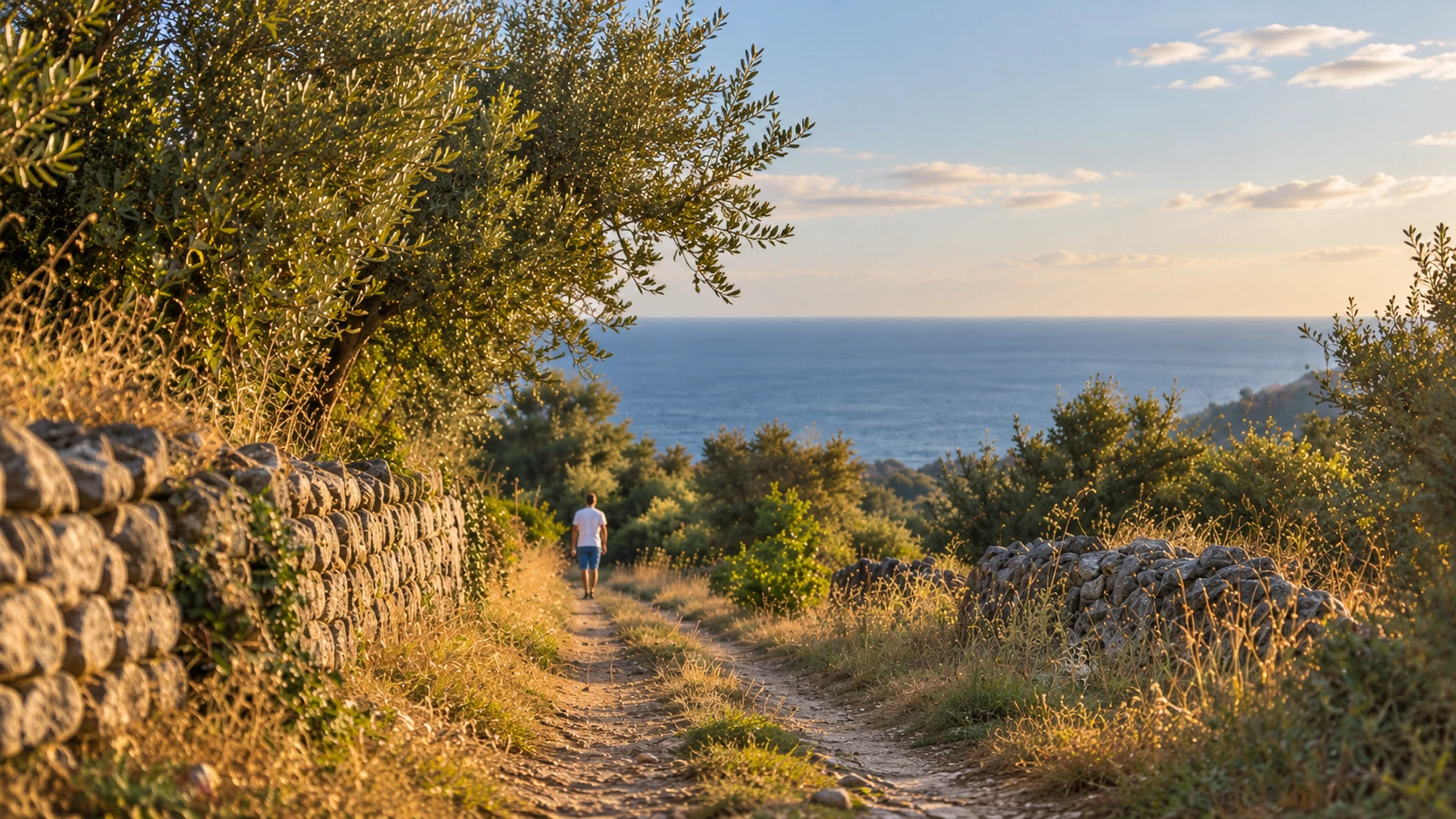
The road climbed gently inland and soon narrowed between reeds, brambles and land that seemed not to have been worked for some time. In places, grass had almost erased the old boundaries, and shrubs growing without order occupied what must once have been fields.
He could no longer see the man with the bucket, but kept going in the same direction, not knowing what he would find.
After a bend he saw him again.
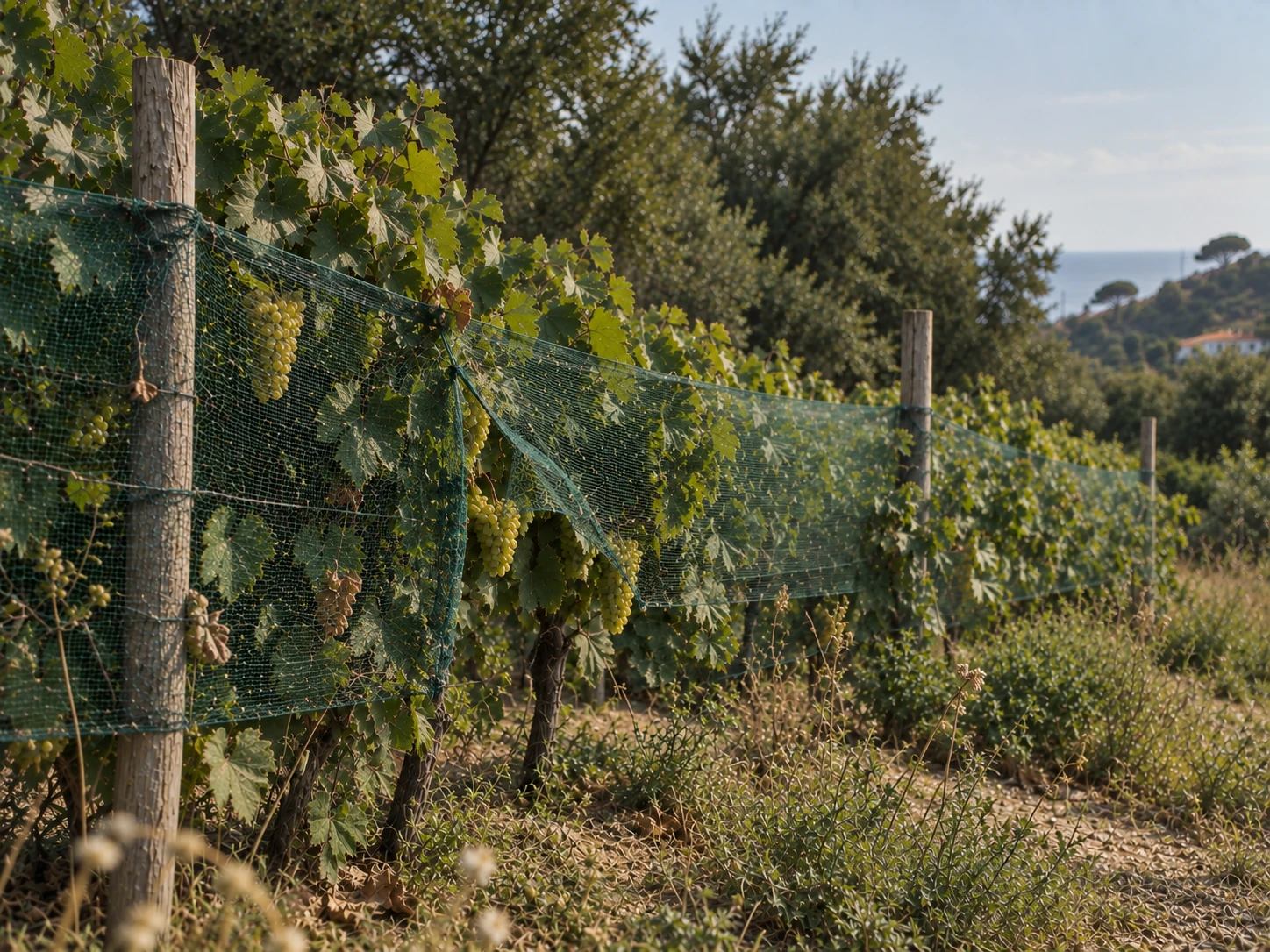
The man with the bucket had left the road and entered a small plot of land. Only as he drew closer did the visitor realise it was a vineyard: a few rows gathered on a strip of earth that seemed, almost by chance, to have escaped the surrounding abandonment.
All around, the grass grew tall and uneven, brambles encroached from the edges, and in places it was no longer possible to tell where one plot ended and another began. In the vineyard, though, the rows still kept their order, and among the leaves were bunches of grapes protected by green netting that the wind slowly billowed and let fall.
The visitor stopped on the path.
He looked at the vineyard, almost waiting for something to catch his attention.
Then he smiled at that very expectation and let himself be absorbed by what lay before him.
Meanwhile, the man with the bucket moved slowly between the rows. Now and then he bent down, moved a leaf or checked a bunch of grapes; once he freed a shoot caught in the netting, wiped his fingers on his trousers and moved on.
He did not look at the sea, although it must still have been visible beyond the fields, and seemed interested in nothing but the few rows of vines before him.
There was nothing extraordinary about what he was doing, and perhaps that was precisely what held the visitor there.
The man did not know he was being watched. He had nothing to show and no reason to make his movements interesting.
At one point he reached the end of a row and set the bucket on the ground. He lifted a flap of netting, took a bunch of grapes between his fingers and turned it slightly towards the light, examining both sides before choosing a grape.
He picked it off and tasted it slowly.
He gave a small nod, so slight that the visitor could not have said whether he had really seen it.
He brushed his thumb across his lips, let go of the bunch and reached towards the netting.
He seemed about to put it back in place.
But his hand stopped.
The man looked at the flap he had lifted. The pause lasted long enough not to seem a mere distraction. Then he slowly lowered his arm, picked up the bucket and set off towards the road.
The netting stayed open.
The visitor followed the man with his eyes as far as the bend, then looked again at the small gap in the green mesh, where the wind slipped through, barely lifting the edges.
He thought of calling out to him.
But the hand had almost reached the netting. It had stopped right there, and before leaving the man had looked at what he was leaving open.
Almost despite himself, he began looking for an explanation. Perhaps there was some reason to do with the vines that he did not know; perhaps the man wanted to let something in, or would be back shortly.
The possibilities multiplied as easily as he had filled the empty rooms of the ruin with lives he knew nothing about.
He let them go.
He did not know why the man had left the netting open.
He kept looking.
Beyond the netting, the orderly rows ran for a few metres before the tall grass and brambles began again. The contrast seemed clearer than when he had arrived: on one side vegetation had slowly erased shapes and boundaries; on the other, each vine still stood in its place and bunches of grapes hung among leaves that someone had just lifted, checked and put back in order.
A little earlier he had searched for people inside abandoned walls.
Here, someone had just been.
He lowered his gaze to the open netting.
He could have reached it in a few steps and put it back in place. It even seemed the most natural thing to do, but he did not move.
That netting did not belong to him.
Nor did that gesture.
He returned to the path.
After a few steps he turned back.
The vineyard was still visible among the uncultivated plots, and the wind kept lifting the flap of netting left open. Farther on, there was already no trace of the man with the bucket.
He looked at it once more, then kept walking.
For a long time an insignificant gesture stayed before his eyes, one he could not forget: a hand that had almost reached the netting, stayed motionless and then withdrawn.