When he walked those paths again, the house that looked towards the land was still on his mind.
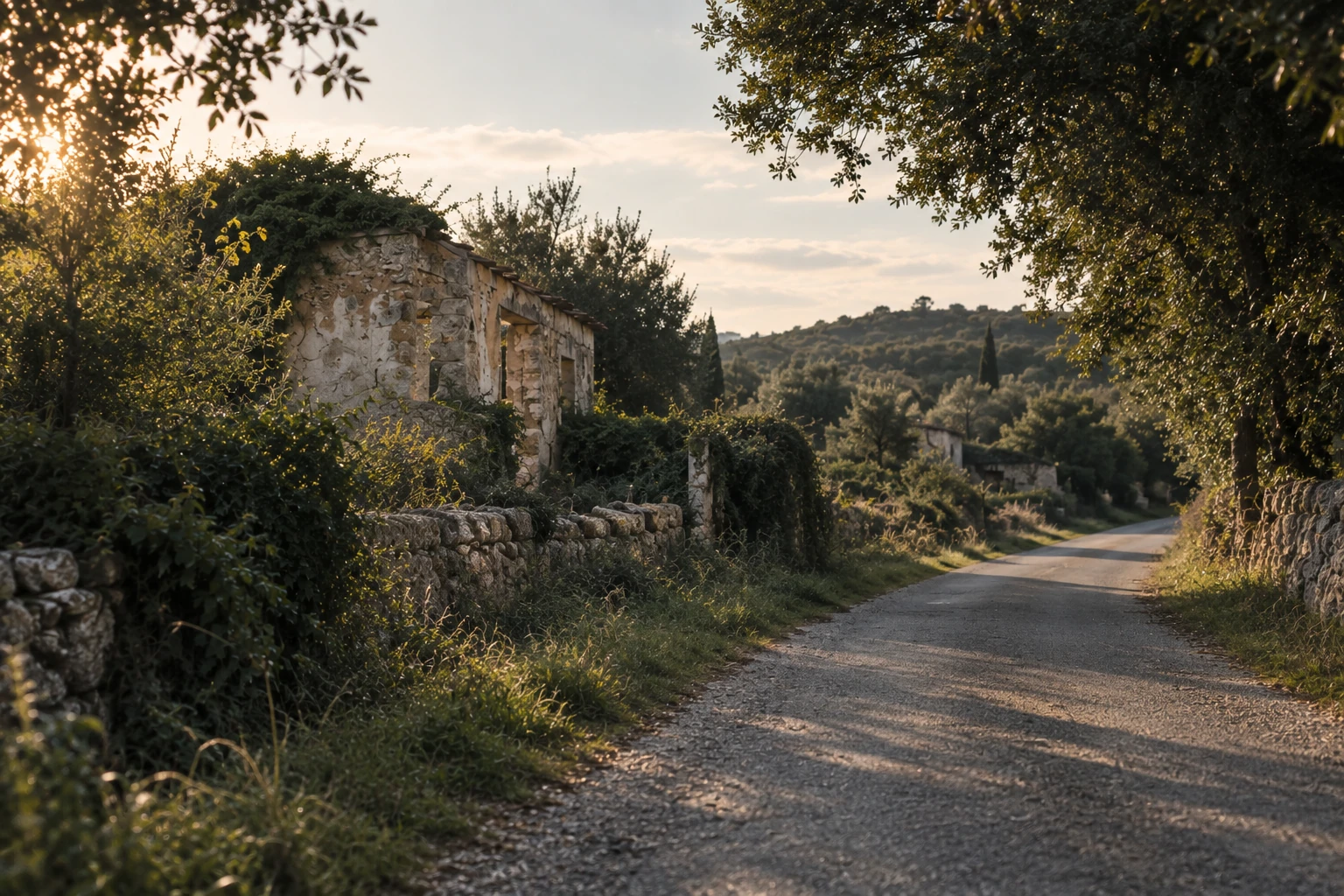
Along the way he came upon another ruin.
He saw it among the trees, a short distance from the road, and slowed down almost without thinking.
It was larger than the house he had found before and, at first glance, seemed even more interesting. Part of the roof had collapsed, but the walls still preserved the outline of the building quite well; traces of plaster survived here and there, and through a large opening he could see the trees on the other side.
He did not raise his camera.
He went straight up to the house.
By now he knew what to do.
Or so it seemed to him.
He began with the openings, trying to work out where the light came in and which might have been the main room. He followed the outer wall until he found what must once have been a door and, where the vegetation allowed, entered the space enclosed by the old walls.
Grass had covered almost everything.
In one corner he found a few blackened stones and studied them, wondering whether there had been a fireplace there. A little farther on, a piece of wood protruded from the earth; he bent down, looked more closely, then moved on.
He tried to bring about what had happened to him in front of the first house.
He imagined someone opening that door in the morning, someone coming home in the evening, a voice from a room, footsteps on the floor.
The images came easily.
Perhaps too easily.
He could put any life he wished inside those walls: a large family, a man left alone, children running outside, someone leaving and someone else waiting. Every possibility seemed to work, and for that very reason none seemed truly to belong to the place.
He walked around the house.
On the other side he found a wall almost entirely covered in ivy and a small opening facing the valley. He stopped before that window, expecting something to change.
Nothing changed, but instead of leaving he returned to the entrance and looked again at the blackened stones. He bent down to examine them, then followed the wall back to the window and tried looking at it from inside, as though a change of position might reveal what had so far eluded him.
He thought of the house that looked towards the land and tried to recall the precise moment when he had stopped being interested in what stood before him and begun searching for the people who were no longer there. He could not remember, because he had not decided to do it: it had happened.
Here, though, each new attempt brought him back to the same details. He returned to the entrance, studied the shape of the rooms and even the path leading to the house, until he realised he was back where he had started.
That was when he realised he was no longer looking.
He was searching.
And he did not even know what for.
When he set off again, he turned back only once.
The ruin was still there, motionless among the grass and trees.
He looked at it.
Then he went on.
Farther on, along the road climbing back towards the viewpoint, he could make out the wall of another old building among the trees.
From that distance he could not tell what it was. Another house, perhaps, or an abandoned storehouse. Part of the wall emerged from the vegetation, and a dark opening offered a glimpse of something inside.
He slowed down.
At another time he would probably have left the path to reach it.
He stayed on the road.
He looked again, almost waiting for the building to stir something in him.
It did not happen.
He began walking again.
When the viewpoint reappeared among the trees, the Guardian was still facing the sea.
The man approached and stopped beside the low wall without speaking.
“Did you find another house?” asked the Guardian.
The man looked at him.
“Two.”
The Guardian waited.
“I stayed a long time at the first.”
“And at the second?”
The man looked towards the road he had just travelled.
“I kept walking.”
The Guardian said nothing.
The man thought back to the first ruin, the rooms he had tried to fill with people, the stories he could have invented without any of them truly belonging to that place.
“How do you know when to stop?”
The Guardian remained facing the sea.
“I don’t always know.”
The man waited.
“That’s why I keep looking.”
There was nothing more.
A little later the man set off again.
When an old wall or a timeworn opening appeared among the trees, he did not quicken his pace to reach it, nor did he immediately seek someone to imagine behind a window.
He looked.
Sometimes something held him there.
At other times he went on.